It’s the fifth anniversary of my cancer diagnosis, and I have some thoughts

Five years ago—on December 4, 2019—I got my cancer diagnosis. I still remember it clearly. Two days earlier, I’d had a suspicious mass in my left breast biopsied. Honestly, I wasn’t thinking much about it because I’d had a similar biopsy two years earlier in my right breast and it was benign (fibroadenoma).

That was Monday. Wednesday evening, my husband had just left to head to trivia night with friends. I wasn’t feeling great, which is pretty normal for me, and decided not to go with him. Shortly after he left, I realized I had a missed call from earlier in the afternoon, so I pulled up the voicemail from a number I didn’t know.

The message was 44 seconds. It’s still on my phone. In the voicemail, the doctor who’d performed my biopsy said she wanted to call because my biopsy results came back early and the office was closing, so she asked me to call her back on her cell phone. At that point, I knew something was wrong, as typically benign reports get uploaded into patient portal and maybe you get a call to let you know. If it was benign, why would she have wanted me to call her back immediately? So I called her back and she confirmed my suspicion—the biopsy was positive for invasive ductal carcinoma (IDC). She noted how surprised she was given my age and having no family history. She let me know that the process would be fast and the office would contact me the next day about scheduling appointments to come up with a treatment plan. I called my husband, asked him to come home, and told him the news. Only then did I cry.

The next month was a whirlwind of appointments, scans, and bloodwork in between work, cookie baking, and holiday festivities. My genetic testing was negative for the common mutations (BRCA), which was great news. I then had a lumpectomy in early January 2020, where they removed two tumors and five lymph nodes, one of which was positive for cancer, making my cancer Stage 2A. A sliver of my tumor was then sent off for additional tests to determine if I would benefit from chemo.

If I’m being honest, this is when I was most terrified—I’m not a vain person but losing all my hair and having a very visible reminder of the cancer kept me up at night. Ten years earlier, I would have had chemo by default because of the lymph node involvement but cancer testing—and especially breast cancer testing—has greatly improved. After my specimen was “temporarily lost” for several weeks, I finally got the great news that chemo would not be beneficial. Instead, I just need six weeks (30 sessions) of radiation.

After some consultations and a “radiation simulation” session, I began my six weeks of daily radiation sessions on March 11, 2020. This happened to be the same day the WHO declared COVID-19 to be a global pandemic. The second day of radiation, we were told we’d need to have masks on at all times. The third day of radiation, they began to separate the radiation patients from other oncology patients.

I turned 40 during my radiation sessions. That was pretty bittersweet. Then two weeks later, I got to ring the bell after my 30th session. I had finished active treatment, and now shifted to regular checkups with my doctors, 5-10 years of an estrogen blocker (tamoxifen), and scans every six months. Earlier this year, I was able to take a test to confirm I didn’t need more than five years of tamoxifen, meaning I can stop next March. This was very good news indeed, as tamoxifen has some gnarly side effects.

Obviously, I still think about my cancer frequently, and I know it could come back at any time. The challenge I think many people have is not letting that fear rule their lives. Here are some things that may have helped me.

I had already been chronically ill for 14 years when I got my cancer diagnosis.

I was a sick kid and a sicker adult. After several years of increasing GI issues in my early 20s, I was diagnosed with Crohn’s Disease when I was 25. Since then, I’ve developed chronic migraines and asthma. I had a bad case of Lyme that took a year to resolve. I have had daily chronic fatigue for well over a decade.

All of this is to say that while the cancer diagnosis was certainly scary, at some level it felt like I had been preparing for this for a long time. Taking daily meds was a part of my life. Regular scans were uncomfortable but not intimidating—I’d had multiple encounters with MRI machines before my first breast MRI.

Breast cancer research is tremendously well-funded.

Thanks in part to former president Bill Clinton, whose mother died of breast cancer, breast cancer treatment is enshrined in law—in 2000, Clinton signed the Breast and Cervical Cancer Prevention and Treatment Act to cover prevention and treatment of cancer. It is also the most funded cancer in terms of research dollars (think billions of dollars), and treatment has evolved quickly. I benefited from these advances in numerous ways—the Oncotype test did not exist 10 years earlier, and it is only because of that test that I didn’t have to go through chemo. My cancer was on my left side, which is problematic because my heart is also there, but radiation treatment has gotten tremendously precise in recent years and I was able to go 30 rounds without fear of heart damage.

Breast cancer is always scary, but I do believe my treatment was much less invasive thanks to all these advances.

My cancer case was very straight forward… or at least as straight forward as cancer can be.

When you get diagnosed with breast cancer, you are also told if it is hormone positive for three types of hormones: estrogen, progesterone, and HER2. I had the most common type of cancer: invasive ductal carcinoma (IDC++-), meaning I was estrogen and progesterone positive and HER2 negative. In other words, my cancer feeds off of estrogen and progesterone, which is why I’ve been on tamoxifen the last five years.

IDC++- has a very straightforward treatment, and when I had my lumpectomy, I got “clear margins” on the first go, meaning when they took out the tumor, they took out a layer of tissue around the tumor and tested it, finding no cancer cells in the outside layer. Yes, my radiation treatment was complicated by the pandemic, but I had no real issues and minimal side effects from it. The tamoxifen is a different story, but even then it has been manageable.

My work situation was pretty ideal for cancer treatment.

If I were to find a silver lining to having cancer treatment during the early days of a pandemic, it’s that I was on sabbatical at the time, which meant I was not having to deal with the many challenges my colleagues were related to shifting classes online, figuring out how to balance work and their small children, and so on. I just had to drive to the hospital each day for an hour to be blasted with radiation. The downside is that I didn’t get a real sabbatical, but I can’t imagine having to deal with diagnosis and surgery and treatment while having all my normal work responsibilities.

I’m a scientist and can (more easily) read and interpret scientific papers.

No, I’m not “that kind of doctor,” but being a PhD and being familiar with research made it easier for me to dig into the literature on my type of cancer and treatment options. I think this helped ease some anxiety.

I also highly recommend the book “Radical: The Science, Culture, and History of Breast Cancer in America” by Kate Pickert. I listened to this shortly after my diagnosis and it was very reassuring.

Being open about my diagnosis helped a lot.

After my surgery, I started emailing a group of friends and family regular updates about what was going on. In these emails, I tried to demystify cancer treatment and walk them through all the various factors being considered. I found the process of writing all this out and focusing more on the science/clinical aspect of cancer really helped me to move beyond purely emotional reactions.

In the years since, I have been pretty open about my dx on social media and that has been incredibly rewarding. We don’t talk enough about chronic health conditions, but many people are affected by them. Many women have reached out to me to share cancer scares or to let me know that my experience led them to get their first mammogram. That makes everything worth it.


I recently had my biannual appointment with my oncologist, and remember telling him that it feels weird that my cancer is the least of my concerns health-wise. While it was an acute health crisis for about six months of my life, I feel lucky that I have only had a few complications in the years since. My other health issues, unfortunately, remain my constant companion and continue to take a toll. The cancer is always lurking in the background, but there’s little I can do to prevent it from reoccurring outside of what I’m doing—taking my meds and getting regular scans.

Five years ago, I was left in a state of shock, but I also knew I had tremendous resolve and a solid support network to get me through this. My colleagues and collaborators took great care of me, giving me a year of Audible credits and officially getting me hooked on audio books. My husband was my rock and took great care of me.

With their help, I made it through to the other end with just two scars to remind me of that time of my life and even more resilience to respond to the things life throws at me. I hope you never have to go through what I did, but if you do, I hope your cancer journey is even easier than mine. Know that I will be rooting for you to kick cancer’s ass.

A detailed accounting of the Vitak family cookie weekend (from 2020)

Back in 2020 when Twitter was still fun/enjoyable and not a total cesspool, I documented that that year’s cookie weekend via 60+ tweets, with pictures. Given I don’t want to direct anyone to visit that platform anymore, I’ve recreated the content here. But first, a quick Q&A regarding the event.

  1. What is cookie weekend? This is my family’s oldest tradition, extending before I was born (2024 marks the 52nd year) where we bake a lot of cookies over three days. The number and variety of cookies steadily increased throughout the 1990s and early 2000s until we were regularly making 3000+ cookies across 30ish varieties. We have been making around 4000 cookies each Cookie Weekend for the last decade, with the exception of 2022–the 50th anniversary of the first time my parents made cookies together for the holidays–when we made 5000+ cookies across 50 types. This took four days and nearly killed me.
  2. How does cookie weekend work? At this point, we have it down to a science. We work in my dad’s kitchen, which is pretty small (I should check the square footage) and a single oven. That oven runs 12-14 hours each of the three days we’re baking. I make all the doughs; my dad does most of the scooping and oven management. My sister helps with the oven management, detraying cookies, and packing cooled cookies in tins. We cover the entire dining room in cooling racks. We have upgraded storage options in recent years to handle up to a dozen cookie trays waiting to go into the oven. We also have an order of baking (with some flexibility), working from the cookies that bake at the lowest temperature (and often the longest) to those at the highest temperature. Most cookies bake at 350′ or 375′. Everything is documented and organized. We have a binder with recipes, a printout with all the cookies and bake temperature/time. I make sure the oven is never empty for more than a minute or two. It’s the only way to make this work with one oven. My family (jokingly?) calls me a dictator but I’d like to think I’m just a good manager. 🙂
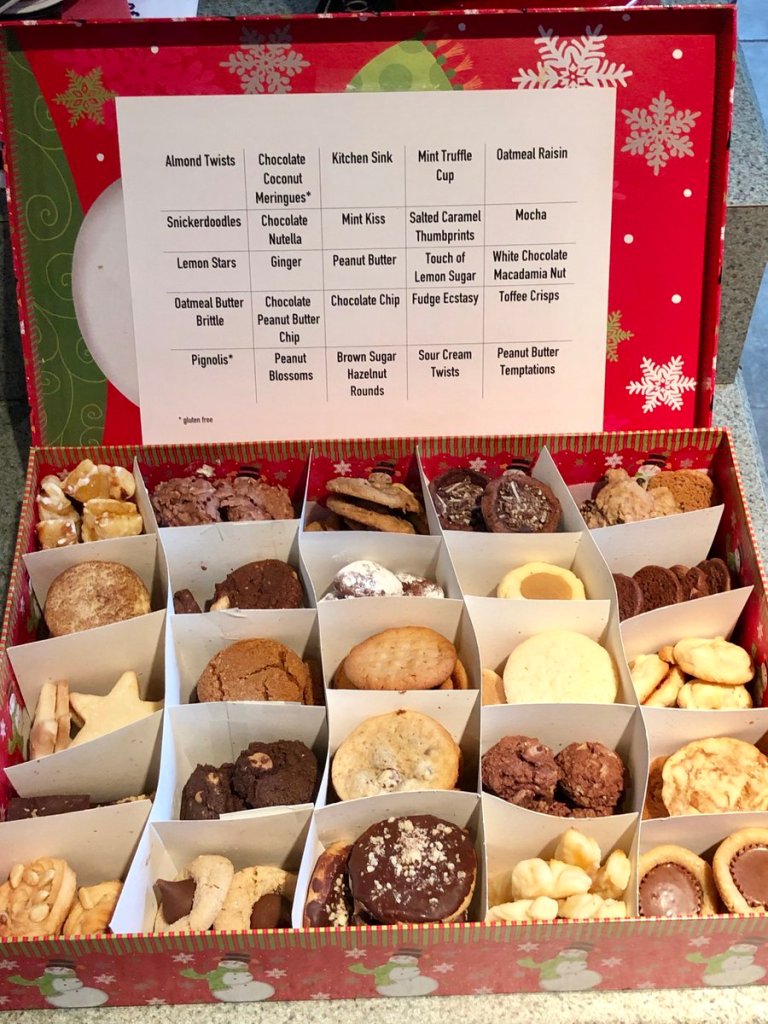
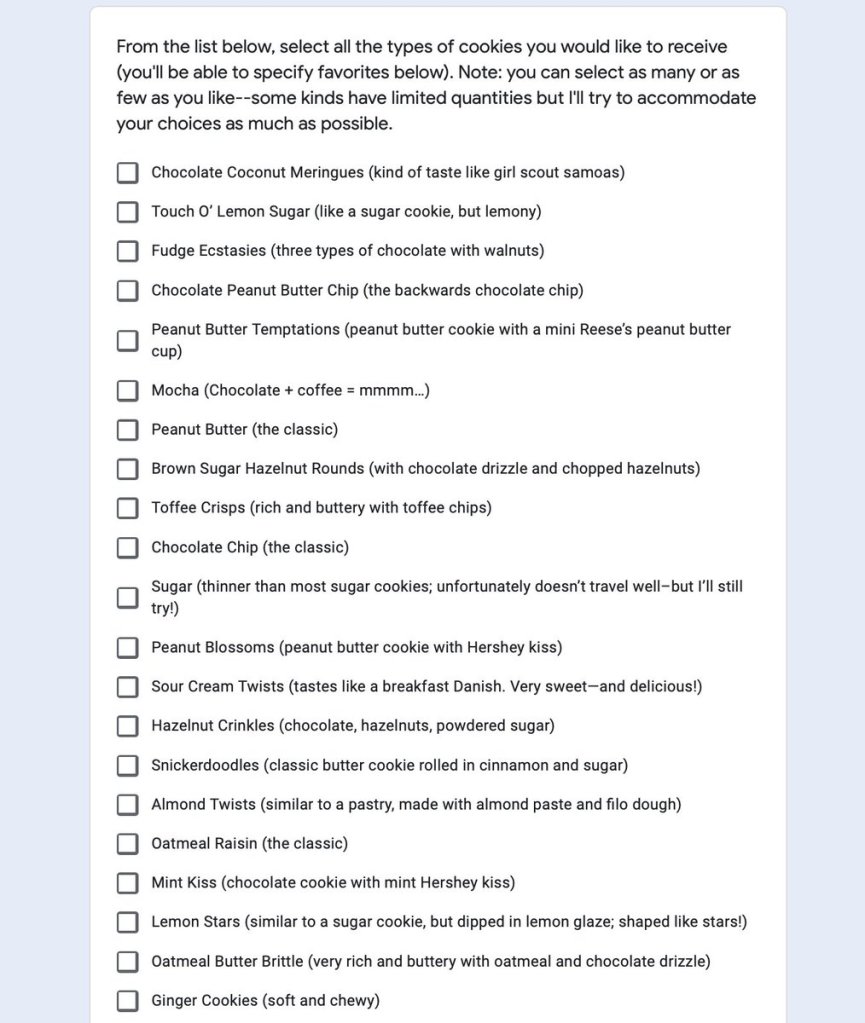
  3. What do you do with all those cookies?? This is the question I hear the most. And the answer is simple — we give 90% away! For many years, I have sent my friends a Google Form where they can build custom orders that I package and mail to them. I take a large box to work (picture below), as does my sister. My dad gives many to friends. Back in 2020, The Eater interviewed me for two articles on mailing cookies, which was honestly a highlight of my career.

So without further ado, here is my very detailed accounting of the 2020 cookie weekend, running from December 11-13, 2020. I kept everything in the original format–including silly gifs–so this will read through like a long series of tweets.


Day 0 (December 10, 2020)


My out-of-office reply is turned on for the next four days because this weekend is COOKIE WEEKEND! This is one of the most important weekends of the year for the Vitaks, as we make 4000 cookies over three days with one oven.

I’m planning to document it this year and capture some of the details that let the magic happen. This year is the first without my mom, and my sister will be at her place (thanks COVID), but I’m confident my dad and I can get this done.

So if you have any questions about the process (like, how the hell do we make 4000 cookies with just one oven? or what do you do with all those cookies?), let me know and I’ll try to respond. Here’s the box I normally take to work each year–but not this year thanks to COVID.

Day 1: December 11, 2020


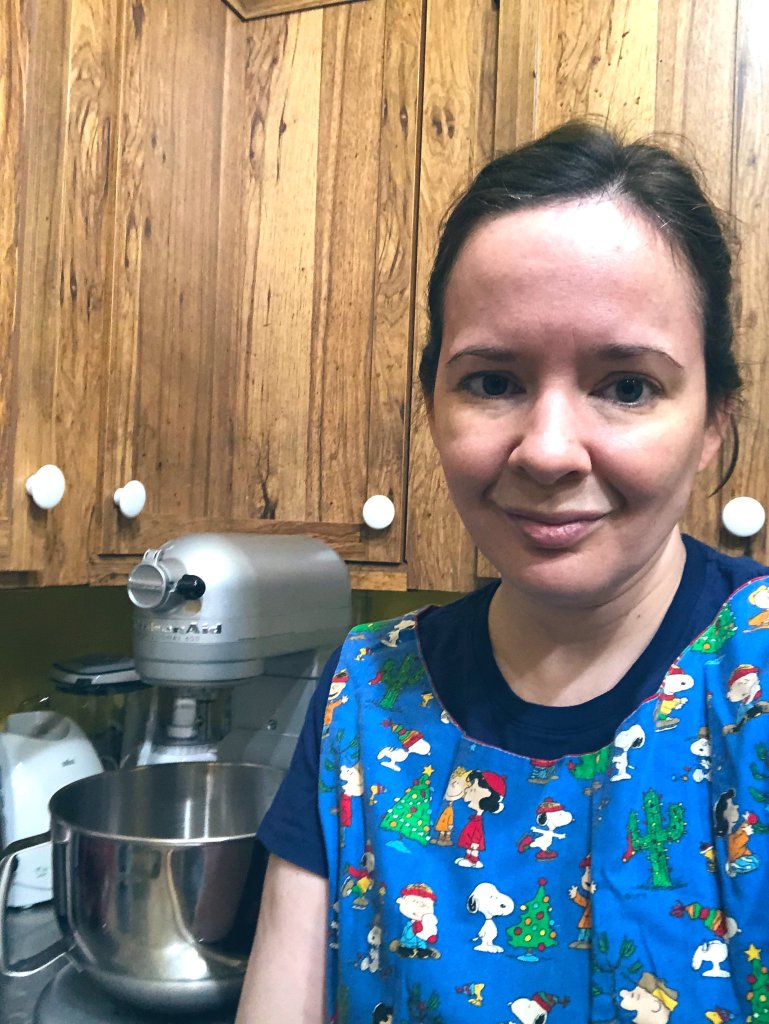
Cookie weekend officially started this morning at 7:30am, which explains why I look like I just woke up. Required uniform: my Snoopy apron.

9:20am: First cookie is done! Every year, it’s always the same cookie (oatmeal raisin), because it cooks at 300’. We try to make cookies from lowest to highest temperature so the oven temp isn’t constantly changing.

10:49am: We’re most of the way through Cookie #2, Chocolate Coconut Meringues. They’re a little different this year because my dad bought fancy “coconut chips” instead of the shredded kind you normally see.

With the large batches, it can mean a lot of flour (9.75 cups for a triple batch of Touch of Lemon Sugar cookies). So I tend to count out loud as I’m measuring, and I’ve been known to count like The Count at times (one ah ah ah), much to the dismay of my family.

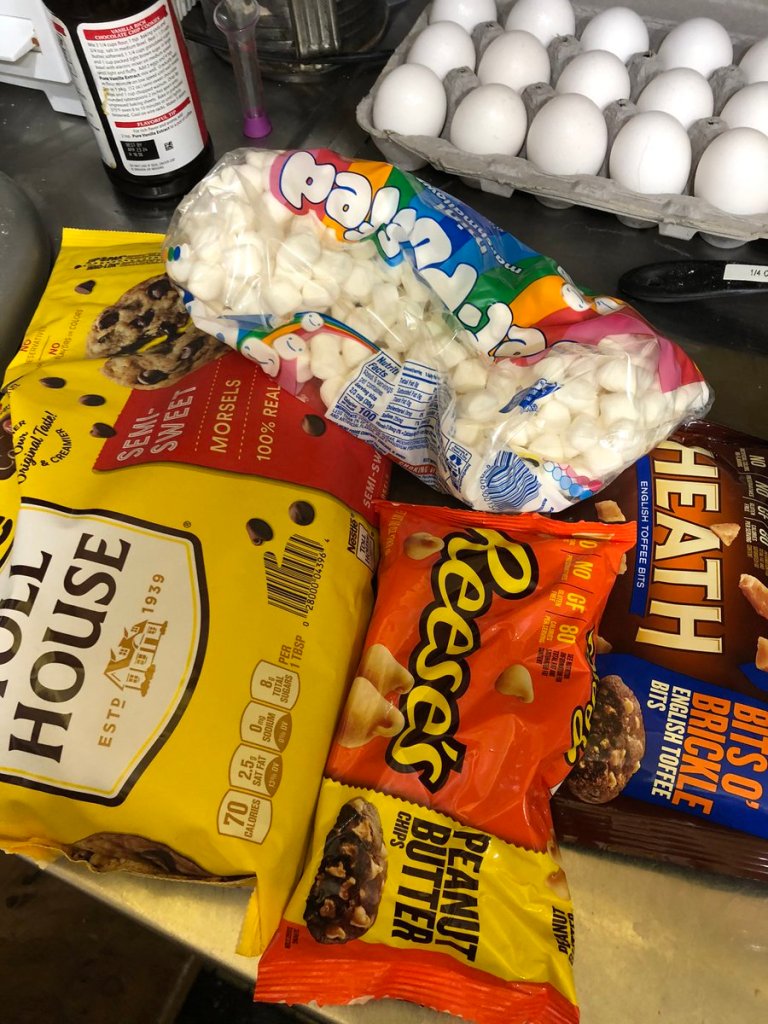
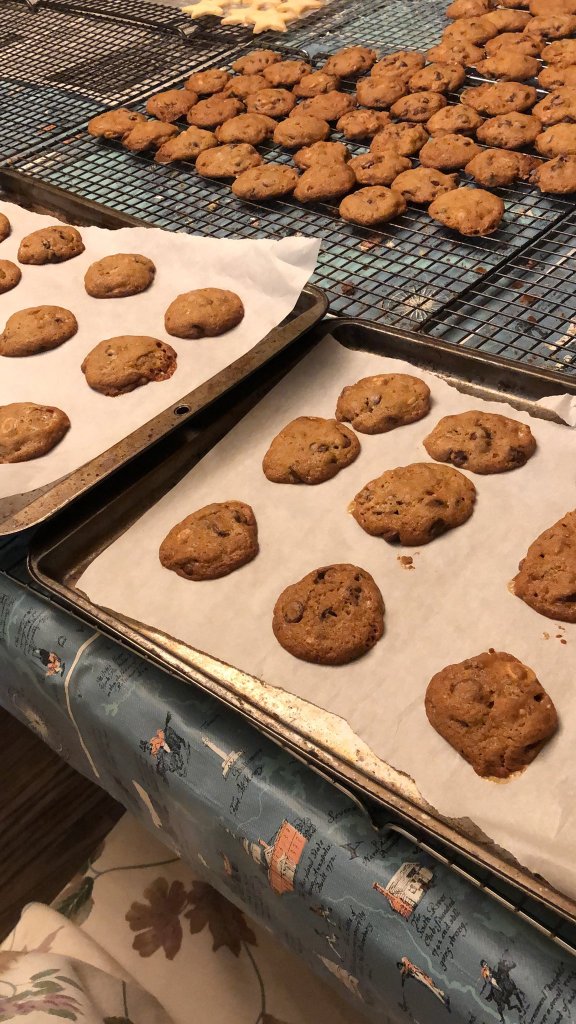
Here’s a cookie you may never have heard of: the aptly named Kitchen Sink cookie. A pretty standard base dough (except for using majority dark brown sugar), with chocolate chips, PB chips, toffee chips, and mini marshmallows. This one’s currently in the fridge chilling out.

Sometimes we alternate between two types of cookies, especially if one takes a lot of prep time. In this case, we’re making Lemon Sugar and Lemon Stars at the same time because we have a limited number of pans for the stars.

5+ hours and 37 dozen lemon cookies later, and we are done with Cookies #3 and #4. Both these are low and slow cookies, which is why they took so long. Now we just wait for the glaze to dry on the stars before we can put them away.

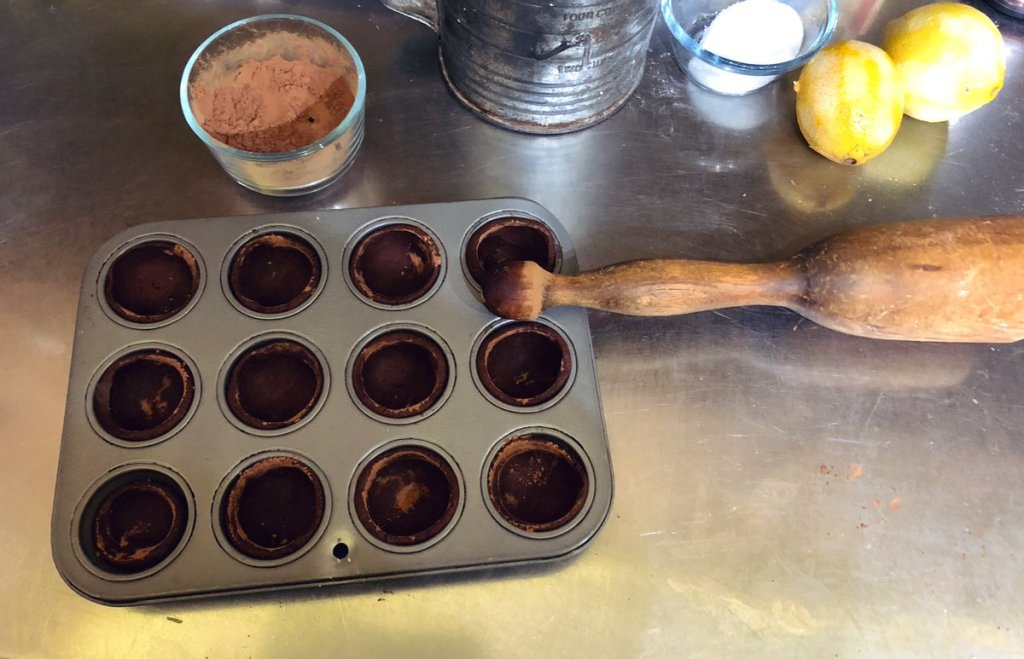
Cookie #5 is Mint Truffle Cups: chocolate cookie, shaped like a cup, filled with chocolate peppermint ganache and topped with Andes Candies. Figuring out how to get the cups deep without holes took years. Our secret: an old potato masher and cocoa powder (to stop stickage).

Cookie #6 is the aforementioned Kitchen Sink. We cook these on parchment because the marshmallow can get everywhere and when it hardens, it’s like concrete.

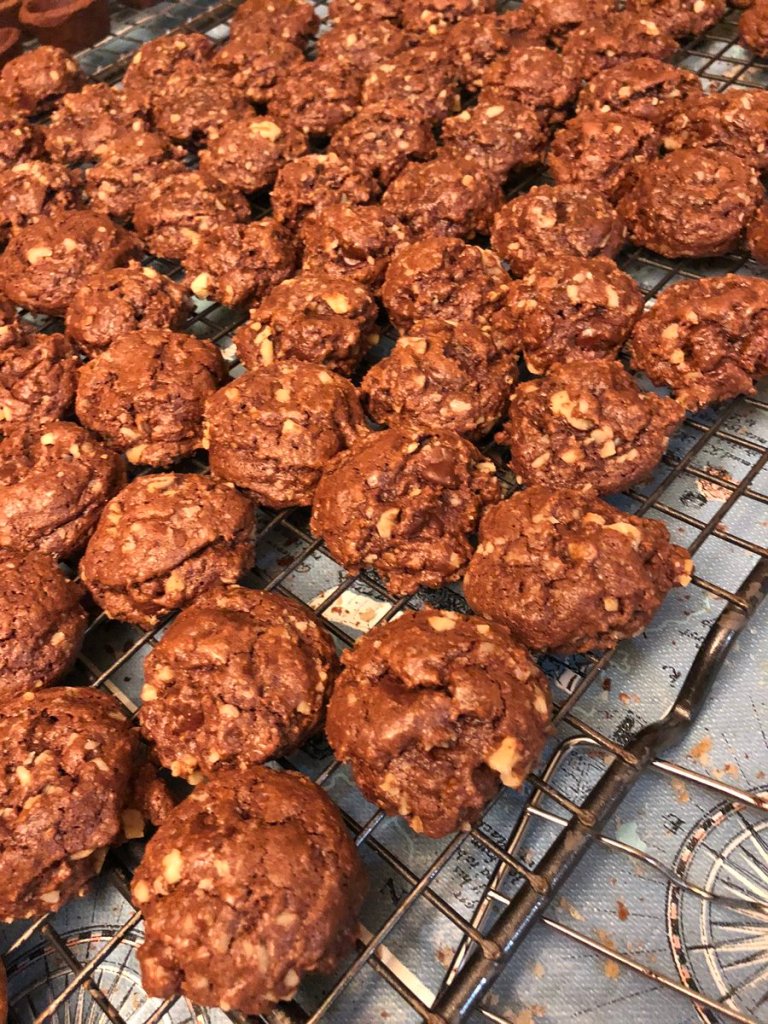
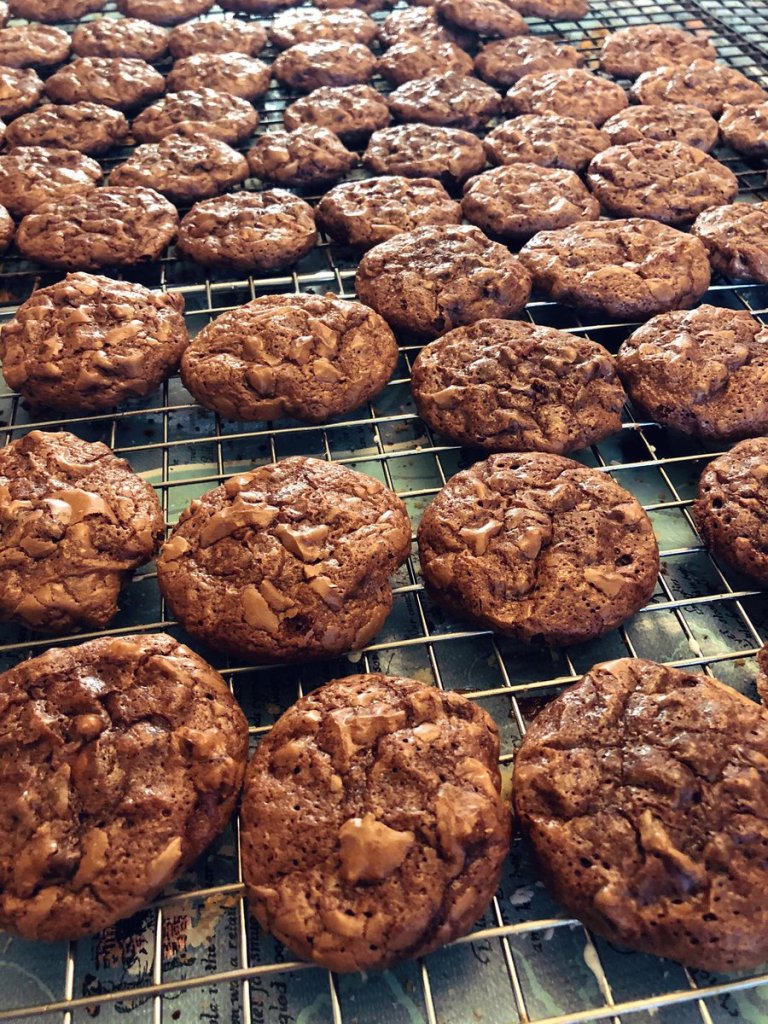
Cookie #7, our final cookie for Day 1, is Fudge Ecstasies. These cookies have a lot of chocolate, a lot of walnuts, and not much flour or butter. They really are fudgy in taste, if not in texture.

Day 2: December 12, 2020

Day #2 of cookie weekend is officially underway at 7:30am. We’re starting by baking up a triple batch of peanut butter chocolate chip cookies. These are one of our largest bakes, yielding nearly 300 cookies. I made the dough last night so we could hit the ground running.

Official shot of Cookie #8, Chocolate Peanut Butter Chip. They’re delicious because chocolate and peanut butter is one of those perfect pairings… like chocolate and most things.

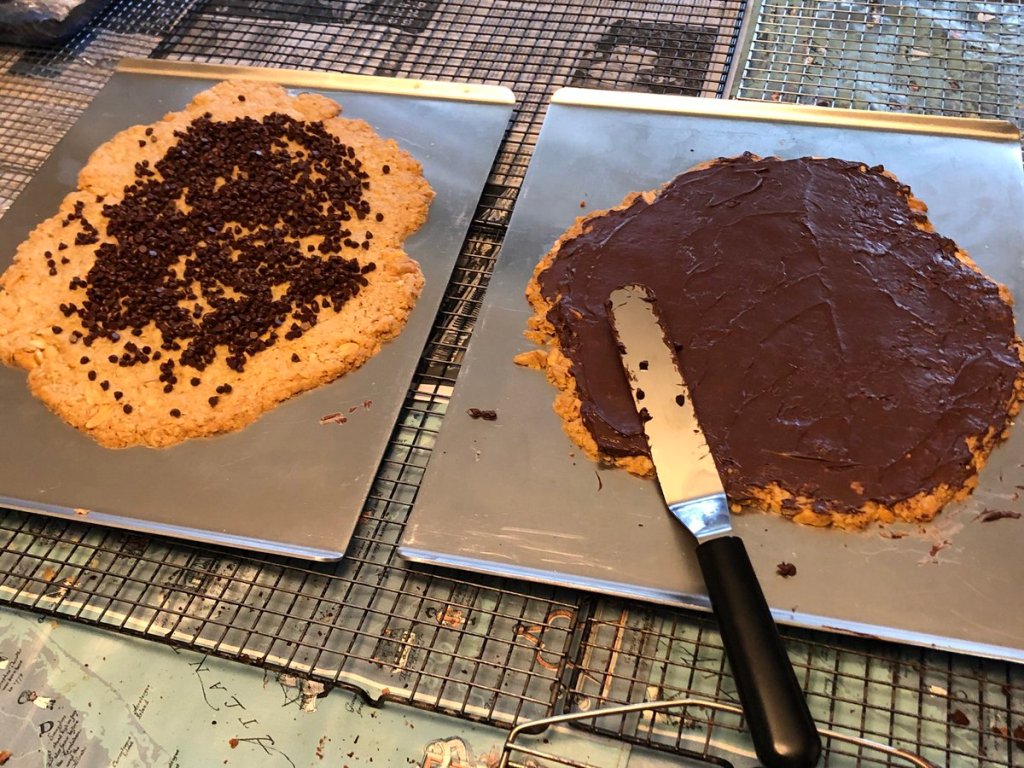
Cookie #9 is Oatmeal Butter Brittle. You make the dough, press it into a sheet pan (or roll it out), and bake. When it comes out of the oven, I sprinkled a cup of chocolate chips on each tray, gave them time to soften, and spread it. Once hard, break it into pieces.

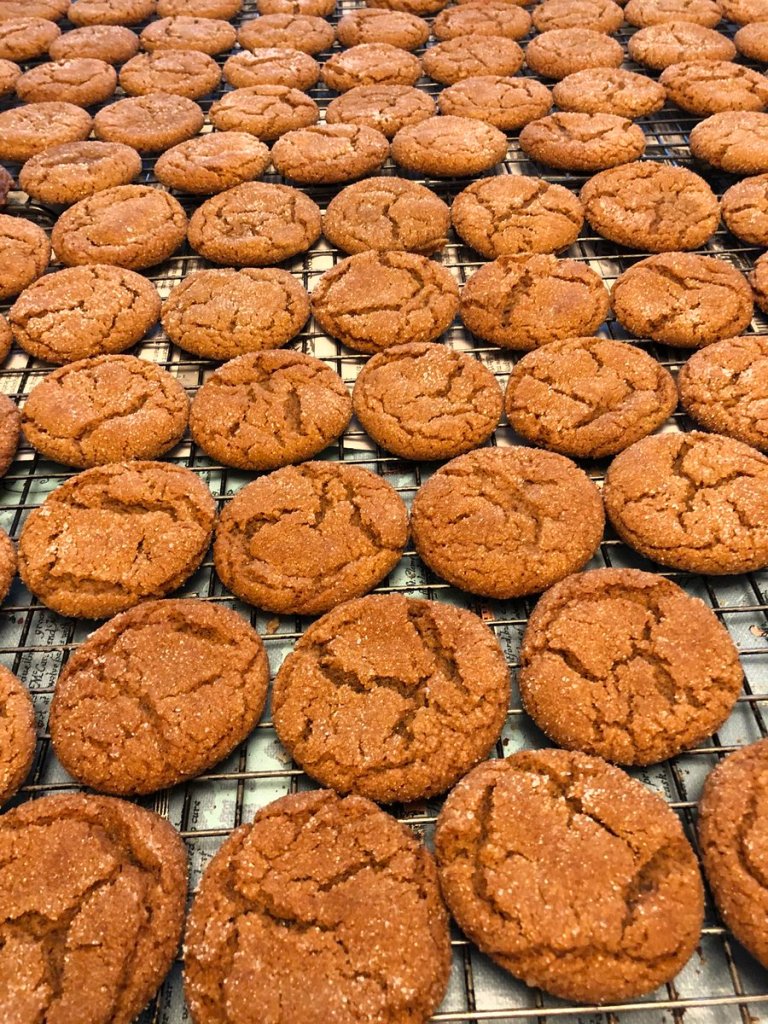
Cookie #10 is Ginger. These are rolled in a ball, then in sugar. I’m not really sure how they compare to other ginger cookies because they’re not my thing. But they look nice!

And now a quick preview of Cookie #11 prep. Any guesses?

Don’t worry, I’m not going to make you wait. The mini peanut butter cups are for Peanut Butter Temptations. You make a basic PB cookie dough, roll in a ball, put in mini muffin tins and bake, then place a PB cup inside as soon as it comes out of the oven.

Cookie #12 is the one, the only, chocolate chip. They misbehaved a bit this year and weren’t cooking evenly, but I forgave them, as it’s 2020 and we’re all a little stressed.

One of the more challenging things with cookie weekend is managing space, especially for cookies to cool before packing. We’re quickly running out of space at the moment because the PB Temptation and Mint Truffle Cups are still setting.

Cookie #13 is Mocha. This is a small batch (by our standards), making 79 of them. But if you like chocolate and coffee, you’ll probably like these.

Cookie #14 is the new kid on the block this year. Every year, the family decides if we want to add or remove cookies from the list. Over the last 40 years of tracking, we’ve made about 80 kinds of cookies. Some are made every year, some just once, and some leave and return years later.

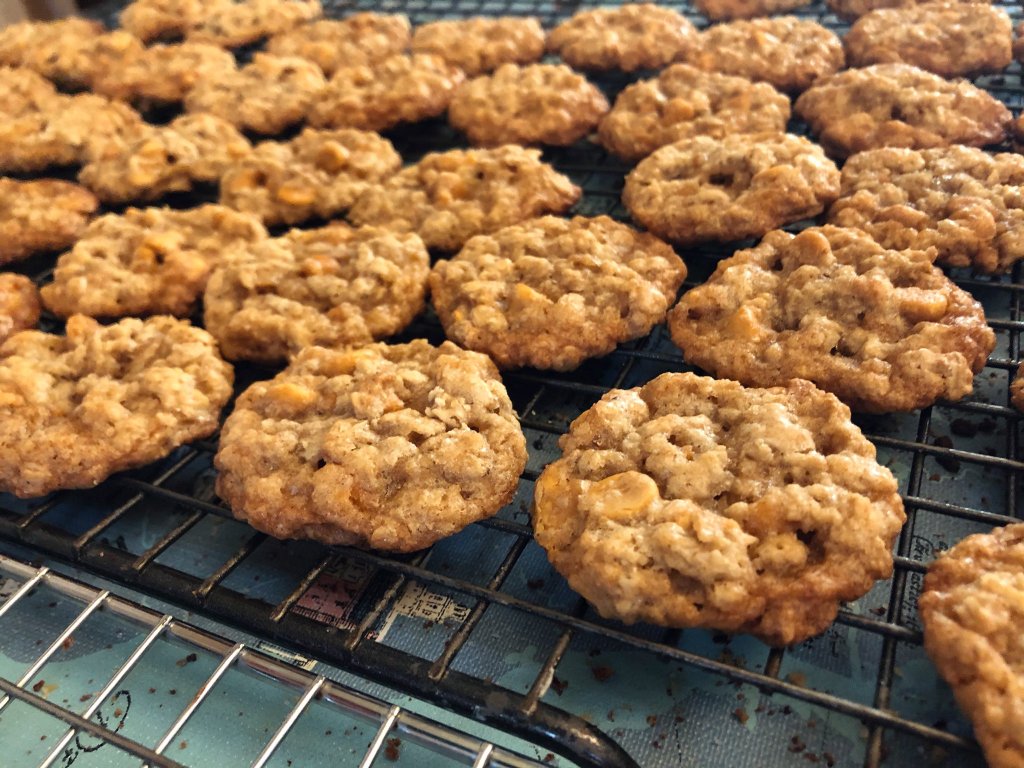
We cut a few kinds this year, knowing it would be difficult to make them (thanks COVID), but we added Cookie #14: Oatmeal Scotchies. These cookies have lots of oats, a hint of cinnamon, and a rich flavor from butterscotch chips (not Scotch).

I can’t even remember exactly how I discovered these. Maybe I was intrigued when I saw a bag of butterscotch chips? This is the recipe on the back of the bag. There’s actually all kinds of interesting baking chips; sea salt caramel chips will make an appearance soon.

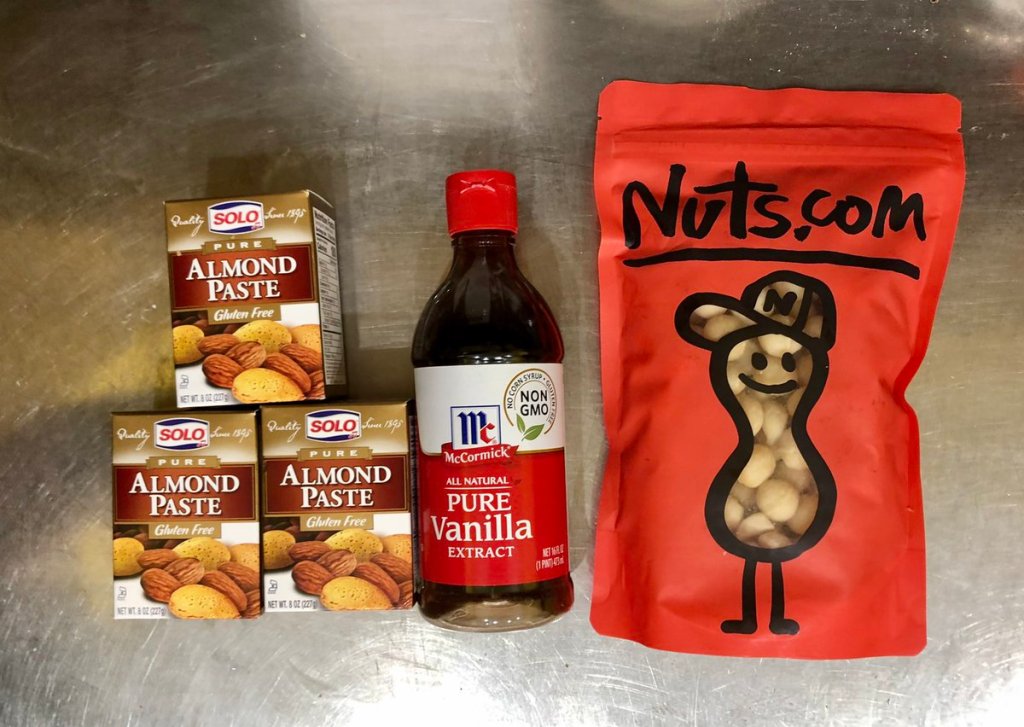
While I give my aching feet a few minutes’ rest, let’s play a game. Which of these was most expensive: a three-pack of almond paste, a 16oz bottle of vanilla extract, or “one yummy pound” (their wording, not mine) of macadamia nuts?

Poll (60 votes; answer comes in Day 3):
*Almond Paste: 20%
*Vanilla Extract: 40%
*Macadamia Nuts: 40%

This small and unassuming cookie may play a cruel joke on you if you think it’s a chocolate chip. It’s Cookie #15, Raisin Nuggets, and I hear it’s delicious from folks who actually enjoy wrinkled grapes.

Cookie #16 is our second newest cookie, only three years in the rotation, and I believe they win the longest name award. Say hello to Sea Salt Caramel Chip Chocolate cookies! Yes, these look a lot like Chocolate Peanut Butter Chip, but they’re very different.

The final entry for Day 2 of cookie weekend, Cookie #17, was introduced to us by a college friend of mine 10-15 years ago. I’m very glad he asked us to make these White Chocolate Macadamia Nut cookies.

We’ll be wrapping up Day 2 in about 20 minutes. Today we made 10 varieties totaling 1594 cookies. Over two days, that’s 2559 cookies. We still have eight varieties to make tomorrow, plus my sister will be remotely making five more. So there’s still lots of baking to share!

Day 3: December 13, 2020

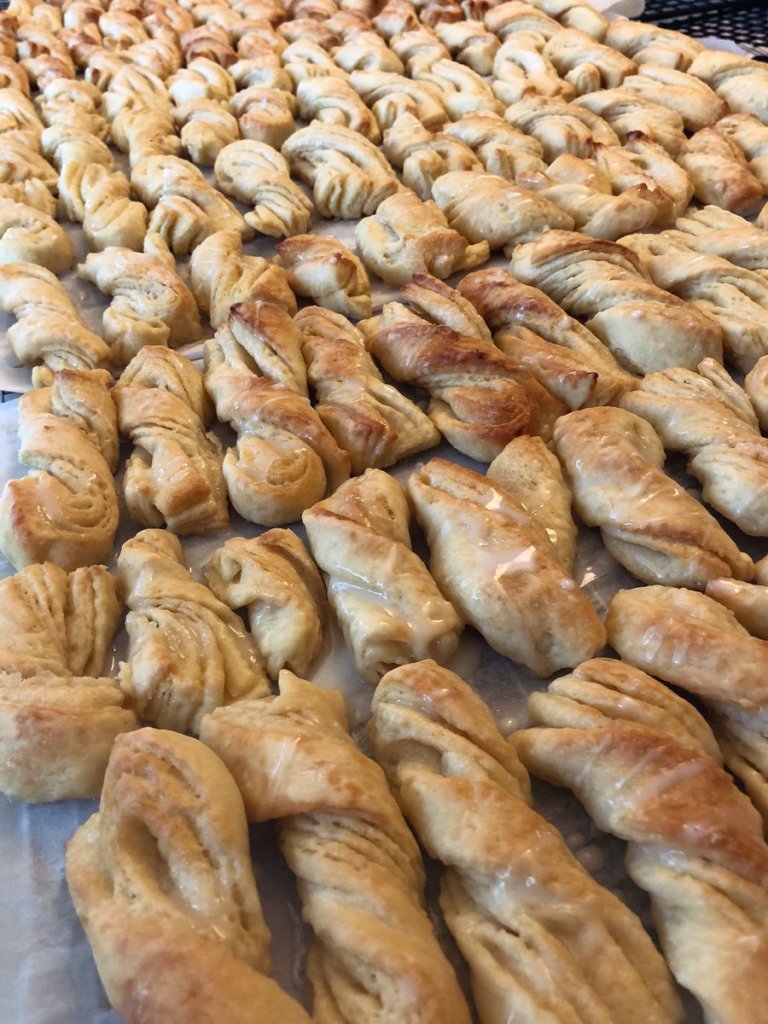
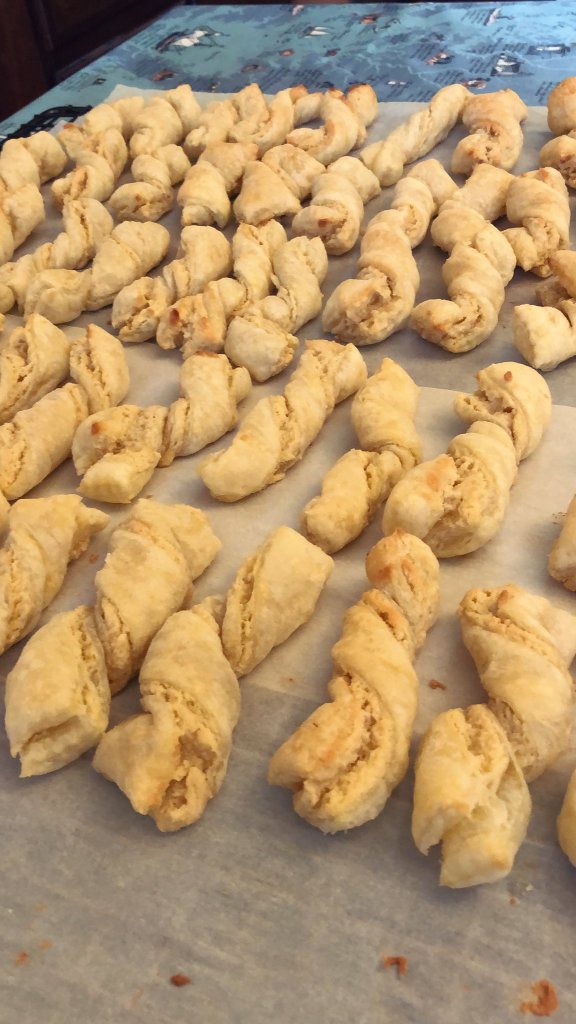
Day #3 of Cookie Weekend is underway. For the last 80-90 minutes, I’ve been rolling out cutting and twisting Cookie #18, which isn’t really a cookie. Sour Cream Twists are a yeasted pastry that you fold in sugar across several layers. These guys are currently rising.

Note that when you want dough to rise, it should be in a warm, draft free place. An oven that’s off but with the light on is the perfect place. These guys already spent 30 minutes in the oven and are waiting for the others to finish up.

And here’s what the Sour Cream Twists look like after baking and a light drizzle of a vanilla glaze.

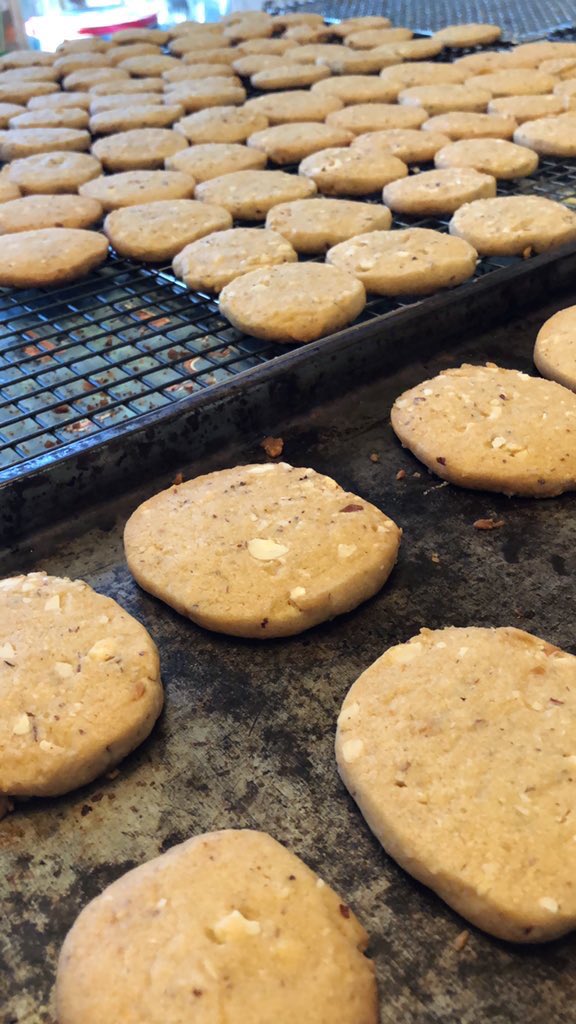
Cookie #19 is Brown Sugar Hazelnut Rounds. They’re currently naked but will soon get a dip in chocolate and sprinkling of hazelnuts. These are one of my favorites and remind me of a Pepperidge Farms cookie. Will post again when they’re dressed.

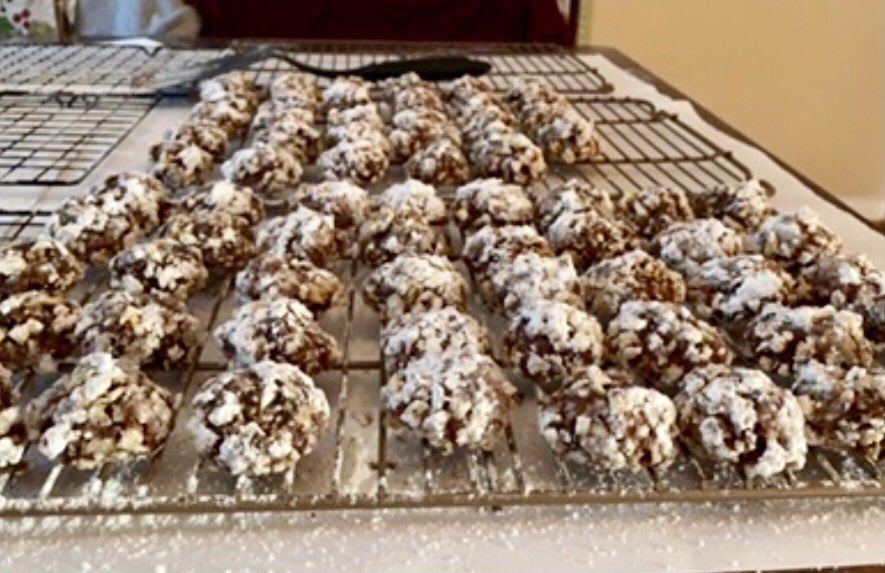
Cookie #20 comes from my sister’s house, where she is busily working to fill her quotas as a Vitak baker. These are her favorite cookie, Hazelnut Crinkles. They’re a PITA to make (roll balls in egg whites, nuts, and powdered sugar) but they taste good.

Cookie #21 also comes from my sister’s house (she was busy last night). This is our second mint cookie, Mint Kiss, where you wrap chocolate dough around a Mint flavored Hershey’s kiss and bake, then dust with powdered sugar. I microwave these for 20sec so the kiss gets soft.

Cookie #22 is one of the few cookies that was taken off our list for several years, then came back 15-20 years ago and has stayed ever since. Say hello to Snickerdoodles!

Cookie #23 is another pastry, this time made with puff pastry sheets that are rolled out. Almond Twists are filled with a sweetened almond paste and glazed after they come out of the oven. Love these!

Remember those naked hazelnut cookies? I’ve been dipping them, and I think they are one of the prettiest final products.

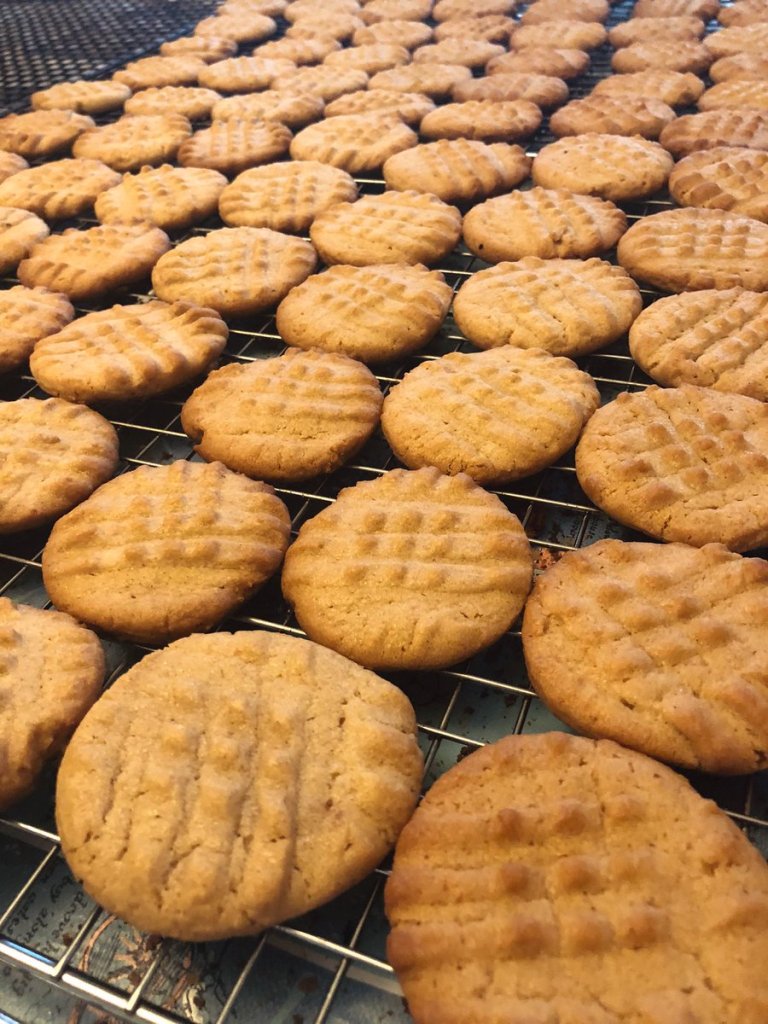
Cookie #24 is the classic peanut butter, complete with the fork crosshatch. These were probably my favorite when I was a kid but I’m not as big a fan as an adult.

I asked my father what happened to this poor cookie, given that nothing else was remotely burned, and he told me that this must have been the cookie’s destiny.

Cookie #25 is coming at you from my sister’s house. An all-time favorite for many: Peanut Blossoms. My sister decided to philosophize about this cookie, suggesting it was indecisive. “It’s a mood,” she says.

We’re in the home stretch friends. Cookie #26 is our second Nutella cookie, Chocolate Nutella. There’s also chopped hazelnuts in this one.

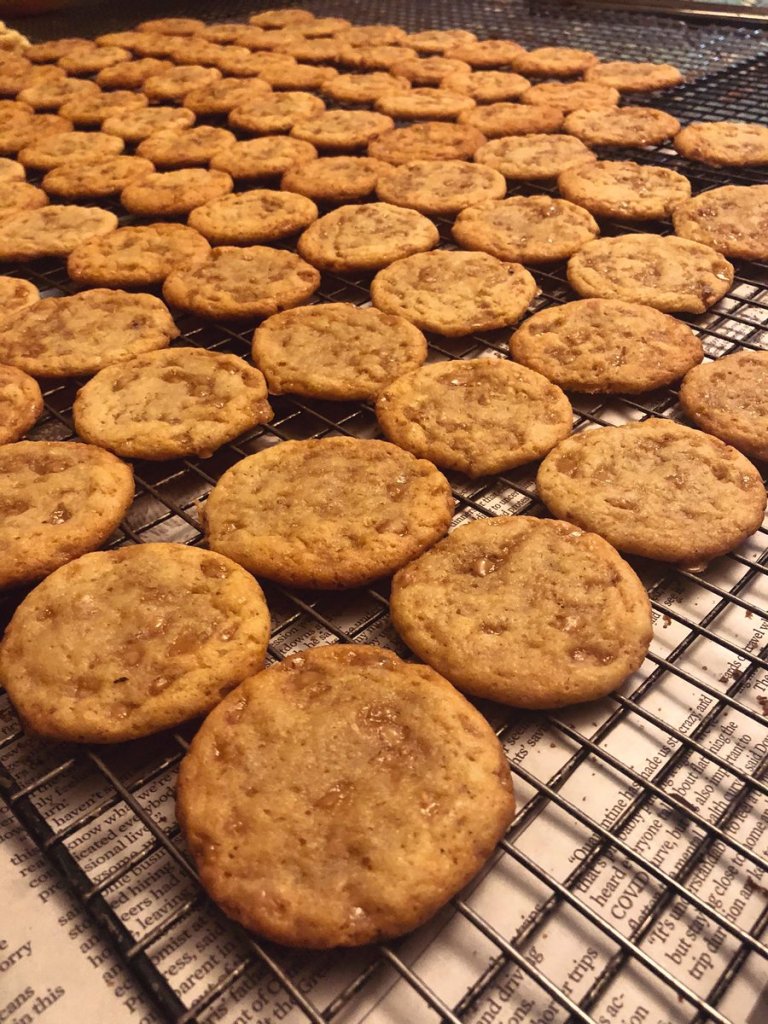
Cookie #27 is Toffee Crisps, which have a rich, buttery taste thanks to a whole lot of toffee “bits.” Once people try these, they tend to keep eating them.

Cookie #28 is Salted Caramel Thumbprints. Basic butter cookie, make a deep impression, and after it cools you fill it with caramel and top with a sprinkling of sea salt. The “caramel” never fully hardens, giving you a soft bite all the way through.

Yesterday, I ran a poll asking which ingredient was most expensive, almond paste, vanilla extract, or macadamia nuts, and 40% of you got it right. 3 pack of almond paste: $18; 1lb whole macadamia nuts: $22; 16oz vanilla extract: $34

You might wonder why vanilla extract is so expensive. Here’s a good thread on the vanilla bean market. Also, imitation vanilla is gross and I would never use it in a recipe; better to just leave it out. [links to this Twitter thread]

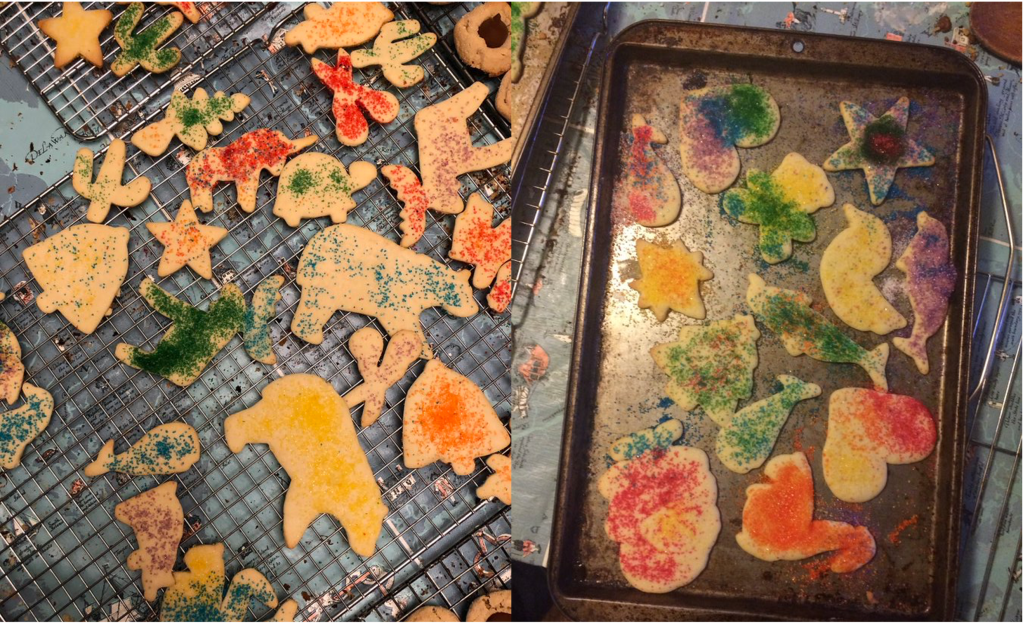
Every year, my mom made the sugar cookies. She’d have each of the grandkids pick out the cookie cutters they wanted to use (we have 100+ of them) and she’d help them cut out a tray’s worth. Then they could decorate the tray and got to take them all home.

More than any other cookie, I associate sugar cookies with my mom. So I’m glad my sister is making them with her children this year so that we still have multi-generations involved. And did I mention we have a lot of cookie cutters?

I’m going to pause tweeting for tonight. Day #4 of cookie weekend is about packing up boxes for mailing and, this year, drive-by pick ups from my house. I’ll share some of this process tomorrow as we begin to send out most of these ~4100 cookies to friends, family & coworkers.

Day 4: December 14, 2020

Okay, let’s wrap up this thread with an overview of what happened on Day #4 of cookie weekend, where I went back to my dad’s house to pack up cookie orders for mailing and pickup.

Before cookie weekend even starts, I send out a Google Form to about 30 friends to let them “make an order” for their preferred cookies. I used to mail out a Word document but the form is much nicer (and I have more data!)

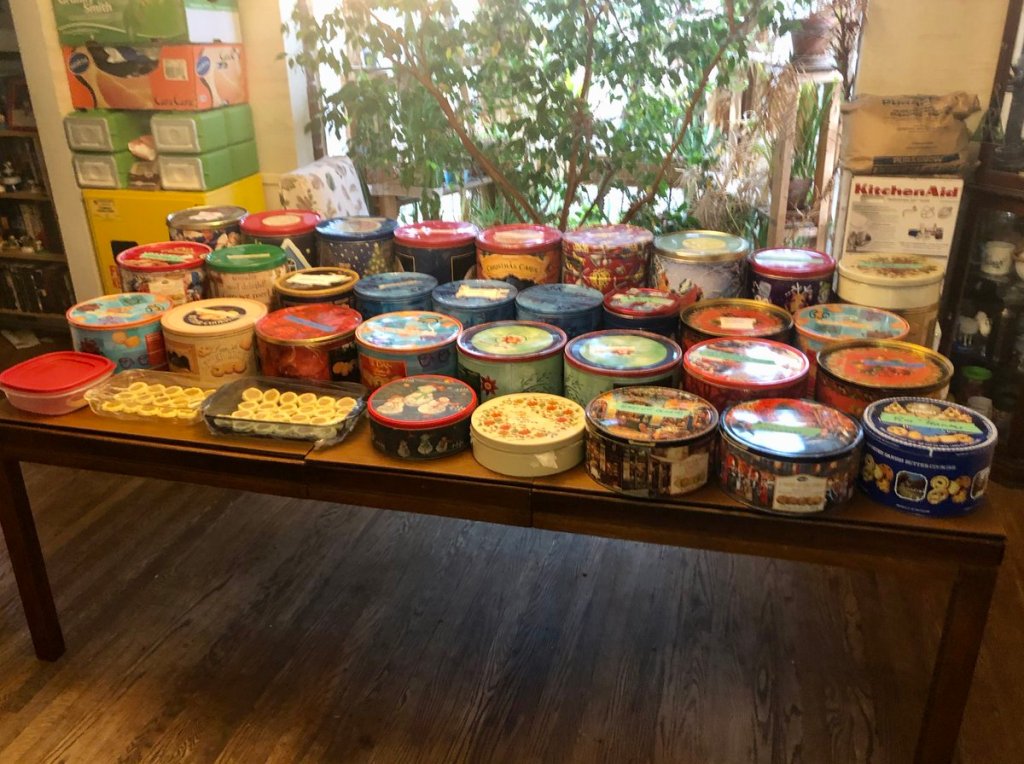
When I get to my dad’s house, we line up all the cookie tins on the dining room table. Sometimes the tins aren’t big enough for a cookie, so they go in multiple tins. They take up nearly the whole table.

Then we take the lids off and it’s time to start packing. I first prep all the custom orders. I have a print out of each one and go around the table filling the order. This year, local orders get placed in a box like this one.

You may notice that the cookies are each in their own bag. I don’t do this for all cookies (there’s 30 kinds, that would be ridiculous), but I separate out the strong flavors–lemon, mint, ginger, and mocha. The other cookies go in one bag together.

Here’s a nice view of what it looks like as I’m making my rounds around the cookie tins filling each order. Try not to drool.

After I fill the custom orders, I prepare general orders with all the more popular cookies. Most of these bags this year were prepared for coworkers willing to trek up to my house to grab a box in lieu of the big box that I normally take the office.

For folks who get cookies by mail, we pack them in USPS #4 boxes (only costs ~$8-$12 for most US destinations). Since my other hobby is card making, I drop in a holiday card as well. These boxes will get packaged up tight with bubble wrap or peanuts before shipping.

For folks who get cookies by mail, we pack them in USPS #4 boxes (only costs ~$8-$12 for most US destinations). Since my other hobby is card making, I drop in a holiday card as well. These boxes will get packaged up tight with bubble wrap or peanuts before shipping.

Every year has its own cookie card, by tradition a pink index card (because that’s what we’ve used since the 90s). My mom would always list that year’s cookies and the number of batches. We add final counts as we bake. Here’s the 2018 card.

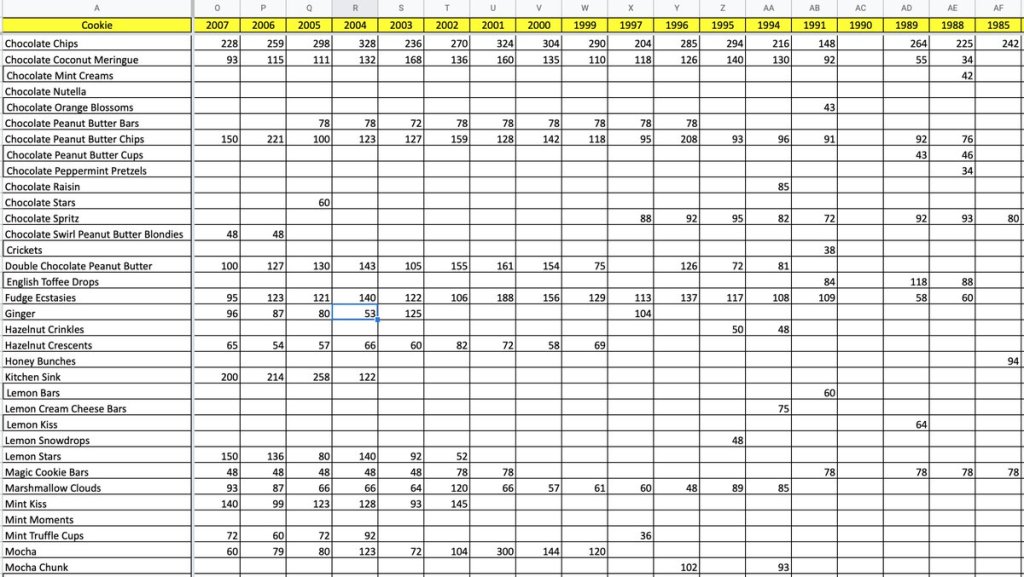
A few years ago, my mom started importing the card data (we have most year’s cards from 1985 onward) into a spreadsheet. The spreadsheet reveals that, over the years, we’ve made *80* types of cookies. Here’s a screenshot.

Now that my dad has become a hardcore baker in his retirement, we have other advantages, like multiple bowls and paddles for our Kitchen Aid. We still need to do a ton of handwashing, but this set of rods next to the sink help with drying.

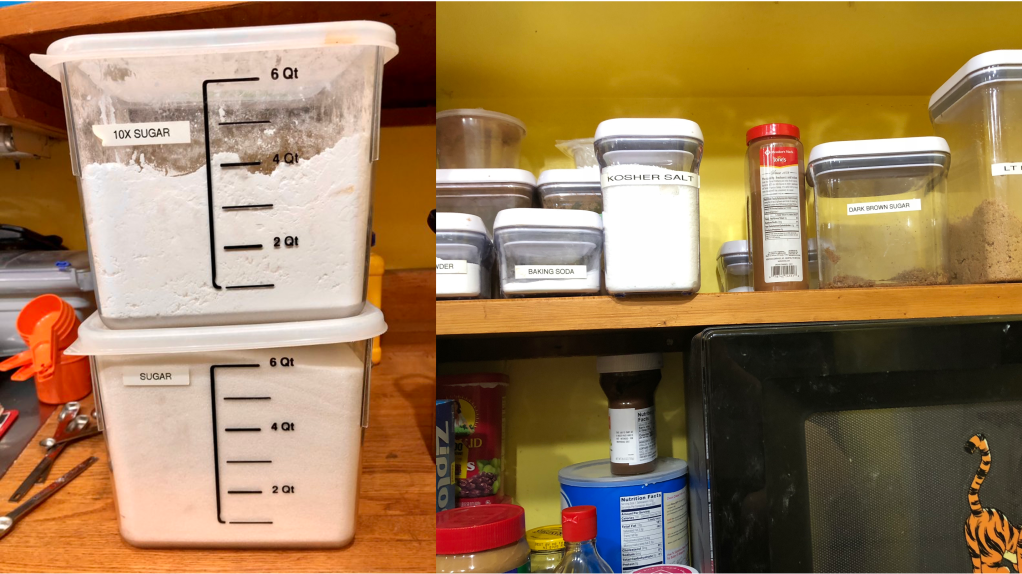
We have big storage containers for key ingredients like flour and sugar. My dad tends to buy these in bulk, and it’s easier to scoop out 5+ cups of sugar or flour when it’s stored like this.

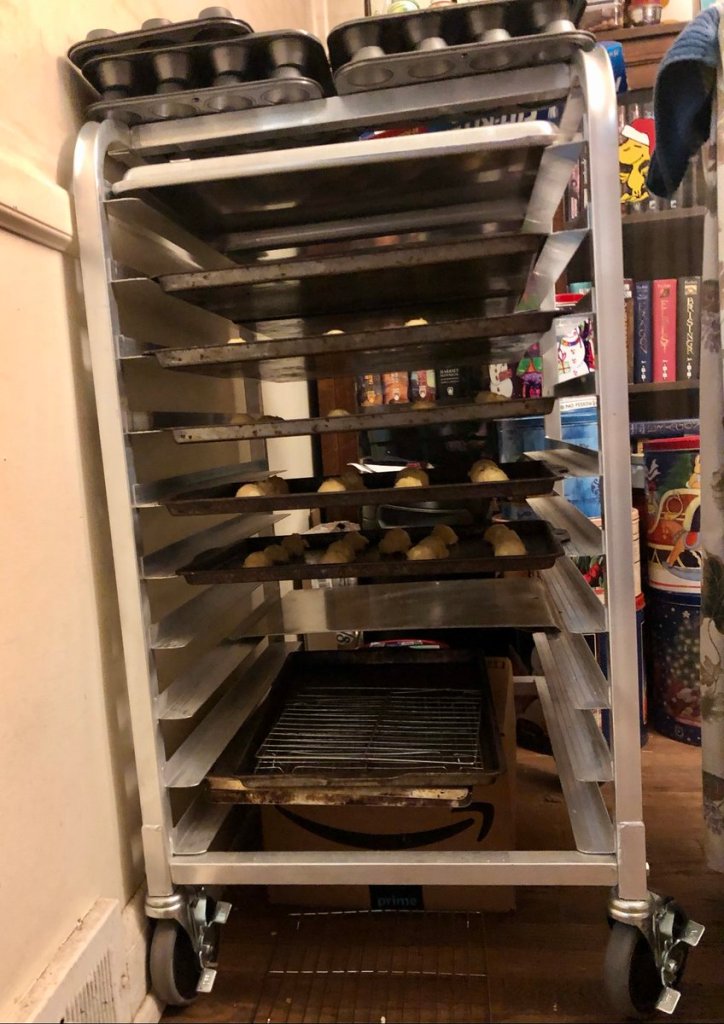
My dad also invested in this, which has been such a help. Not sure it’s real name, but it’s a tray holder, and can hold 20 baking trays up to quarter-sheet size. We used to precariously store trays waiting to go in the oven around the perimeter of the dining room before this.

Finally, we have our “cookie binder” (no picture, but it’s just a binder) with all the cookie recipes in plastic sleeves. Importantly, we also add notes to these printouts with helpful information, like changes to cooking times, best weight/size of cookie, and so on.

In the end, what we do may seem like it’s magical, but it’s not. It’s the result of a whole lot of love, determination, and practice. We do this because we love sharing our family tradition with friends and colleagues, and it brings happiness to us when they enjoy the cookies.

And to top off everything else, I just discovered the folks at @Eater tested out different mailing options for cookies (including mine (!!) from a previous interview/article) and outside of appearance, I’m pretty sure my method came out on top. 🙂
Link to article: https://www.eater.com/21611746/how-to-send-cookies-in-the-mail

My mom may no longer be with us, but I know she’d be happy to see this tradition continuing, and she’d be proud of my dad, sister, and I for making sure folks still got cookies during the pandemic. I think people need cookie love this year more than ever before. Love you mom. ❤

And with that, my epic cookie weekend thread is finished. Thanks for following along; I think doing this was a bit therapeutic as I deal with this being my first Christmas without my mom. Next up, I’ll work on compiling recipes to share with anyone who wants them.

Embracing Failure: Here’s My CV of Academic Rejections

Note: Last Updated November 2023 (link to PDF at bottom)

A few days ago on CNBC, I saw this article on a problem especially rampant in academia, and one that I’ve talked about on numerous occasions: the perception that successful academics never fail in their work. Every manuscript is accepted! Every grant proposal funded! Jobs are thrown at them. This (mis)perception is very much in line with one of my primary streams of research on how people engage in impression management/identity curation in digital spaces. On social media, this is often framed as FOMO (fear of missing out)—we see everyone around us living glamorous social, work, and family lives while we sit at home on a Friday night.

In academia, this framing of success can be problematic at multiple levels. First, for students just starting out, they may not be properly prepared for dealing with failure—which is more common than success on several metrics. If they assume success, the failures will be that much harder to process. I know of at least one graduate student (not from UMD) who did not finish her degree because she could not/did not want to deal with rejections of research she had put so much effort into. Did the program do her a disservice by not preparing her for the reality of academic publishing?
Don’t get me wrong—academia and the work atmosphere within academia are NOT for everyone. You develop a thick skin pretty fast or you get out. But something as simple as professors sharing their stories of failure or even preparing students when submitting research papers that the acceptance rates are very low (some under 10%) helping students find the journal that best fits topic AND quality rather than telling them to shoot for the moon and submit to the “best” journal in the field.

Melanie Stefan posted a blog in Nature in 2010 highlighting the benefits of sharing your failures with others. Transparency is so important to avoid false expectations and to prepare young academics for rejection. Beyond that, it’s important to highlight that EVERYONE fails. EVERYONE in academia gets rejections. Mark Granovetter’s canonical paper, The Strength of Weak Ties, was rejected at first. Joe Walther’s work on the hyperpersonal model—which has influenced hundreds of research papers in my field—was rejected from at least the first journal it was submitted to. In class, Joe shared share that his graduate advisor expressed serious concerns about his ability to become a successful academic; today, Walther is one of the most respected Communication scholars in the discipline.

While I am not nearly as well-known or established, I have experienced my fair share of academic rejections over the last decade, and I want to be as transparent as possible about these failures to show that for all my successes, they are complemented by a lot of rejections. Therefore, I’ve put together as comprehensive a list as possible of work-related rejections. My hope is that young academics will read this post and see that it is possible to be successful and fail regularly—and that failure is OKAY! I also hope to encourage other academics to be more open about their struggles to provide a more realistic portrayal of academic life.

PDF: Vitak CV of Failures October 2023

Review of danah boyd’s 2014 book, “It’s Complicated”

The following appears in the most recent edition of the Journal of Broadcasting and Electronic Media. 
TO CITE: Vitak, J. (2014). It’s complicated: The social lives of networked teens by danah boyd (Book Review). Journal of Broadcasting and Electronic Media, 58(3), 470-472. doi: 10.1080/08838151.2014.935944


BOOK REVIEW OF: boyd, d. (2014). It’s complicated: The social lives of networked teens. New Haven, CT: Yale University Press. 271 pages.
When I was a senior in high school, I joined America Online, which was, for many of my generation, our first real taste of the Internet. I often chatted with friends through instant messenger, but I also spent many late nights exploring the topic-specific chat rooms talking with people who shared similar interests. Most importantly, I used AOL to locate and introduce myself to current and fellow incoming students at my future college, gaining both friends and valuable information before I ever stepped foot on campus.

Even though my introduction to mediated social interactions occurred more than a decade before the interviews highlighted in danah boyd’s new book, It’s complicated: The social lives of networked teens, I found myself easily identifying with the perspectives and experiences these teens shared as they navigated identity, privacy, and relationships via technology. In many ways, not much has changed: teens today face many of the same challenges growing up that their parents and grandparents did. At the same time, however, the evolution of the Web and increasing ubiquity of mobile phones has increased parents’ and lawmakers’ focus on the safety and privacy of the youngest—and presumably most vulnerable—users. And as we have seen throughout history, new technologies are often accompanied by new fears, especially when they are not well understood.

Boyd challenges readers—and especially parents of adolescents—to put fear aside for a moment and consider why young people are engaging with these technologies. For most teens, social media and smartphones serve a critical relationship maintenance function. As boyd notes, “Most teens are not compelled by gadgetry as such—they are compelled by friendship. The gadgets are interesting to them primarily as a means to a social end” (p. 18). She supports her argument with more than a decade of ethnographic work talking to teens, parents, teachers, and other adults working with youth, as well as 166 formal interviews with teens around the country. Boyd’s passion for the topic is evident on every page and in every description of an interview subject. It quickly becomes clear to anyone reading the book that boyd is deeply invested in getting teens’ perspectives on technology and sociality “right”—when popular media have so often gotten the story wrong.

Boyd tackles a range of issues, including addiction, “stranger danger,” cyberbullying, socioeconomic inequalities, and digital literacy. Throughout, she highlights the inherent tension between privacy and publicity, diving deeply into the personal narratives of the teens she talked to during the height of MySpace and Facebook’s popularity among this population. It is here, within these anecdotes, that we hear the stories not covered by media. For example, sisters Ashley and Alice described very different relationships with each other and their parents; the discussion highlights how parents and teens can frame conflict in significantly different ways (bullying vs. “drama”) (pp. 129-130). Likewise, while Tara’s use of social media may seem like an “addiction” to outsiders, she views it as “a social necessity” (p. 84) to keep in touch with friends because her parents restrict her free time.

Boyd is perhaps best-known for her work describing networked publics—“publics restructured by networked technologies” (p. 8) and containing affordances and dynamics that facilitate new outlets for interaction and relationship formation. It is therefore unsurprising that her discussion of identity and privacy are especially engaging, as she deftly uses narratives to show how the structure of these systems and the context within which they are being used influence social outcomes. But an even more important discussion is found in the chapter on literacy, in which she contests the underlying assumptions of digital natives:

“The notion of digital natives…obscures the uneven distribution of technological skills and media literacy across the youth population, presenting an inaccurate portrait of young people as uniformly prepared for the digital era and ignoring the assumed level of privilege required to be “native” (pp. 179-180).

As with all of boyd’s writings, I thoroughly enjoyed this book. The book will provide a quick read for anyone interested in the social impacts of communication technologies. She is adept at transforming sometimes-complex concepts into clear and accessible passages and has a gift for telling a strong narrative. If anything, I was disappointed by the amount of content in her book that I have read before in other venues, as this book covers 10 years of data collection and many of the topics have been covered in previous publications. On a more minor note, I felt myself wanting to see her reflect a more deeply on her findings at times and tie them back to theory, even though I recognize the strength of her work is in the personal stories of her participants.

This book is a must-read for parents trying to understand and navigate the many communication technologies available to and being used by their children, if for no other reason than to calm a pounding heart. More importantly, this book can help parents educate themselves about the real threats their children may face when navigating social applications and those that are imagined or exaggerated in media or urban legend. As boyd astutely notes, there are a lot of misconceptions about social media use and misuse, as well as a gap between what parents think their children do on these sites and the purposes for which they actually use them (pp. 84-85). Therefore, by educating themselves about teens and social media, parents can open a line of communication with their children about responsible use of technology.

Extending the conversation: Academic publishing in the digital era

Yesterday, I shared a takedown notice I received from WordPress (who had been contacted by Elsevier) for a paper I posted on the Papers section of my website. The pdf was the final version of the paper, violating the publishing contract I had signed with Elsevier before publishing the paper. I removed the pdf and replaced it with a pre-press version. My reason for complying with the takedown notice was largely motivated by the fact that (1) I did sign a contract and (2) I am still able to share my research as long as I do not post the final, paginated versions.

Since yesterday, the post has been viewed over 400 times. It was a brief, quickly written post, mainly intended to share the takedown notice. But it appears that my experience, in combination with the Academia.edu takedown notices, is causing an uptick in conversation about academic publishing and open access, and I would encourage readers to continue the conversation here. While I am not an expert in open access, copyright law, or related issues, here are some of my initial thoughts (which I will update as the conversation evolves):

  1. A number of people have told me (primarily through tweets) that they disagree with my stance of “caving” to Elsevier. I understand the righteous anger people feel toward Elsevier and other publishing giants–Elsevier’s 2012 profits exceeded  £2.063 billion (see page 12 of their annual report). The products on which they largely generate revenue are “free”–the researchers who submit and publish their manuscripts are not compensated, nor are the reviewers who spend an often significant amount of time working to improve the quality of the research.
    That said, if I have signed a contract, I believe I should honor it. Going forward, I may change my behaviors (and I will discuss this below), but I cannot change my past behavior or alter the contracts I have already signed. One person who I interacted with through Twitter yesterday (@Protohedgehog) shared this article with me, and I generally agree with the sentiments shared in it: signing a contract with a publisher clearly transfers ownership to the publisher and most contracts clearly outline what versions you can use and share for your personal use. In most instances, you are allowed to post pre-print versions on your personal websites (see Elsevier’s policy), which is what I have done on my site. While there have been instances in which I or my coauthors have been inconvenienced in having to reformat a paper for posting online, there have generally been few issues with ensuring we are able to share our research with as wide an audience as possible.
  2. One of my colleagues today approached me and said he disagreed with my post and that he posts the final versions of his papers as an act of “civil disobedience.” Again, while I share others’ disagreement with many of Elsevier’s policies, when I asked him how he would respond to a takedown notice (assuming he had signed a contract saying he would not publish the final version), he was less than confident. For myself, I do not want to risk a RIAA-style witch-hunt (for a refresher, see this post by the Electronic Freedom Foundation).
  3. While I use this workaround as a way to share my research, I agree with many that academic publishing is deeply flawed and the academic community must be more active in trying to reform it. In my discussions with others on Twitter yesterday, several people noted that change needs to occur at multiple levels, including both on the corporate (publisher) side, as well as within academia itself. One point I noted yesterday was that young academics–PhD students and untenured professors–are often under greater pressure to publish their research in highly ranked journals, who also are typically run by companied like Elsevier. In fact, many universities’ tenure requirements list a set of journals assistant professors must publish in to obtain tenure, so these academics are constrained by their position. Does this mean that departments should reconsider how quality of work is evaluated–in other words, as @denzil_correa said, “A paper in X indicates quality. A paper not in X doesn’t indicate bad quality. Classic logical fallacy!”
  4. Oren (@OrenTsur) noted that people in this position can still choose to not review for Elsevier journals, even if they cannot participate in a full boycott such as the Cost of Knowledge boycott (which has more than 14,000 signatures). There is a significant moral dilemma here. On one hand, young researchers who still feel compelled to publish in these venues could start to get inferior reviews; this is contrary to my belief in my role as an academic involved in academic publishing, i.e., that we must strive to improve the quality of academic work by imparting/sharing our knowledge. On the other hand, refusing to review for these companies implicitly says that we will not stand for their practices. Which stance is better?
  5. The Cost of Knowledge boycott raises several other issues with these publishers, namely the high subscription charges, which are becoming increasingly burdensome to university libraries, as well as lack of access (without paying a ridiculously high fee) to individuals who do not have institutional access. If you are not familiar with these, you may want to read up on them. Here are some examples of articles on the boycott.
  6. Someone from Elsevier responded to my tweet with a link to Elsevier’s official comment on takedown notices and their options for hosting content. They stressed their open access policies, which for final versions run from $500-$5000. These policies are pretty standard, and I have only ever heard of a one academic paying the fee. Many academics are pushing for more open access issues within journals that are generally behind paywalls. For example, Zizi Papacharissi, editor of the Journal of Broadcasting and Electronic Journalism, opened the final issue of 2012 for one year (I know this because I have an article published in the issue). There are also highly ranked journals that are fully open access (the Journal of Computer-Mediated Communication is an example), but these are few and far between. Discovering opportunities that allow researchers to make their research available in high quality journals without placing a cost burden on them should be a priority.

These are some of the issues that make up part of the current debate. There are more that I haven’t touched on. I encourage readers to add their thoughts and comments below.

Notice to academics: Be careful what (articles) you post online

Update [12/12, 1:40pm]: I have written a more in-depth post on the take-down and my thoughts on this issue here.

——-

In the last couple days, news has been spreading of Academia.edu receiving takedown notices from Elsevier and notifying users that it is automatically complying with requests from the publishing giant by removing content without the user’s authorization (see this story by Venturebeat).

This has certainly caused a lot of talk in academic circles about academic publishing rights, open access, chilling effects on sharing research, etc. I have additional news to contribute to this conversation that I have kept to myself until now, but is probably important for academics to know and, if necessary, take action on, to avoid similar problems. Elsevier has not limited itself to Academia. It’s looking elsewhere, including personal blogs. And I received a DMCA takedown notice from WordPress (who was contacted by Elsevier) on November 22. See a copy of the takedown here (with identifying information removed).

I take full responsibility for the takedown request. When we publish papers in journals, we sign contracts that designate what we can and cannot do with the content. I am a firm believer in sharing my research with the world, but I try to always share pre-press versions to be in line with these agreements. In this case (as the takedown notice was for a single paper), I accidentally uploaded the wrong version. I removed it immediately.

I encourage all my academic friends out there to review the content they have published online and make sure it complies with whatever publishing guidelines are specified for the given journal. While I believe in open access, openly defying a giant like Elsevier by publishing final versions of papers from their journals will get you nowhere. And it is clear that they are actively searching for people in violation of the terms of agreement for publishing.

CSCW 2014 paper: Facebook Makes the Heart Grow Fonder: Relationship Maintenance Strategies Among Geographically Dispersed and Communication-Restricted Connections

In this CSCW paper (my second at the conference), I analyze a subsection of data from my dissertation, focusing specifically on the question of how (a) one’s use of Facebook and (b) Facebook-derived relational outcomes may vary between geographically dispersed vs. geographically proximate Friends, as well as between Friends who rely primarily or solely on the site for communication vs. those who use alternate channels such as phone calls, emails, and face-to-face interactions.

To analyze this question, I had participants in my study log into Facebook and select a pseudo-random* Facebook Friend for whom they would answer a series of questions. These included a number of questions related to relationship maintenance strategies they could engage in through the site (e.g., sending birthday wishes, communicating about a shared interest), their perceptions regarding the extent to which their use of Facebook affected the quality of the relationship, both in terms of how close they felt to the other person and the relationship’s stability, general relational closeness, frequency of communication through a variety of Facebook-specific and other communication channels, and other measures. To read the full study’s methodology, see my dissertation.

The findings for both geographic distance and use of Facebook as the primary communication channel were the same: when controlling for a dyad’s existing level of relational closeness, participants reported engaging in a greater amount of relationship maintenance strategies through the site and believed the site to have a more positive effect on their level of relational closeness and relational stability with the Friend for whom they were responding. What this finding in particular, and my dissertation to a larger extent, support, is that there are specific types of relationships that benefit more from using the site as a relationship maintenance tool. This likely has to do with a number of factors: for example, in my dissertation, I found that weak ties who were highly engaged in relationship maintenance behaviors on the site saw the site as much more beneficial than strong ties who were highly engaged in these same behaviors. From this finding, it is a small jump to Haythornthwaite’s work on media multiplexity, whereby stronger ties use a greater quantity of communication channels.

However, in this study, I controlled for relational closeness, meaning these differences emerged regardless of how close participants rated that relationship outside of their use of Facebook. This suggests that something deeper is going on. Much as the work of Keith Hampton and Barry Wellman more than a decade earlier argued that email was supplementing other forms of communication when “richer” forms were unavailable, Facebook may be filling that void now–and why not? It’s ubiquitous, mobile, easy to use regardless of age, and easy to share content like photos and videos. And as Hampton recently noted, SNSs like Facebook have this quality and being persistent and pervasive, perhaps changing the relationship lifecycle forever.

If you want to learn more about this paper, you can read it here, and you can come see me present it at CSCW 2014 in Baltimore this February!

*Because of the way Facebook’s algorithm works for Friend display, generating a truly random selection would be difficult if not impossible. For more on this method of participant selection, see this paper by Ledbetter et al. (2011).

CSCW 2014 paper: “You can’t block people offline”: Examining how Facebook’s affordances shape users’ disclosure process

I’m very proud of this qualitative paper I worked on this spring with UMD iSchool student Jinyoung Kim and will present at CSCW in February (in Baltimore–woot!). This study analyzes a robust qualitative dataset I gathered in 2011 as part of my comps but had to put aside when I began my dissertation research. So I was very excited to finally be able to dig into the 26 interviews that I *knew* held such rich insights about SNS users’ disclosure and privacy practices, their perspectives on their network and how they manage that network, as well as the cognitive thought processes behind the interactions (or lack thereof) that occur on the site.

For this paper–the first of at least two analyzing this dataset–we focused on how users balanced disclosure goals and risks by first identifying the goals and risks they perceived on the site (applying Omarzu’s disclosure decision model as a guiding framework) and then exploring the various strategies users employed to manage risks they associated with sharing information through the site. We categorized these strategies into four types:

  • Network regulation strategy: These behaviors limit the official recipient of disclosures and include leaving Friend requests pending, defriending, and hiding. Notably, many participants referenced pressure to accept Friend requests (or conversely, to not defriend someone they wanted to) because of their relationship with that person. This could be a classmate, the husband of a best friend, or a neighbor, but in these cases, the participant said s/he couldn’t engage in boundary regulation due to the nature of the offline relationship.
  • Targeted disclosure strategy: These behaviors involved sending content to a segment of one’s network, either by using the Friend List feature or using the advanced profile settings to place individuals or groups on a Limited Profile. In addition, people used Friend Lists to restrict specific people or groups from seeing content; for example, one user maintained a “don’t see” list that couldn’t see any of her status updates.
  • Self censorship strategy: These behaviors ranged from disclosure decisions resembling Hogan’s lowest common denominator approach to a more broad-based self-censorship in which users chose not to share certain types of content with anyone on the site. As the sample for this study was comprised of graduate students (master’s and PhD), many were motivated by specific self-presentation goals and strived to keep their profile as free from “drama” as possible.
  • Content regulation strategy: These behaviors include moving content from public to private channels (on Facebook or elsewhere) or communicating on the site in code, much like danah boyd describes in her work on social steganography. Some participants differentiated between the types of information they shared through public channels (e.g., Wall) and private channels (e.g., private messages), but a few said they regularly used these private channels to keep up-to-date with a small group of close friends. Likewise, a rarely mentioned strategy was to interact through the public channels but to talk in code, as one participant described when telling a story about how she and her friends talked about a professor they weren’t fond of by calling him by a made-up name (e.g., Dr. X).

Overall, this study expands our understanding of the disclosure process in online environments, which contain a number of unique affordances that affect how people think about and make decisions related to what and with whom they should share personal information. This study also has implications for research in the area of context collapse, especially when considering the various strategies individuals employed to manage the diverse groups of Friends they had on the site (the average number of Friends per participant was 500).

You can read the full study here and I hope to see some of you at CSCW in February!

INFOGRAPHIC: Pew data on civil liberties & national security

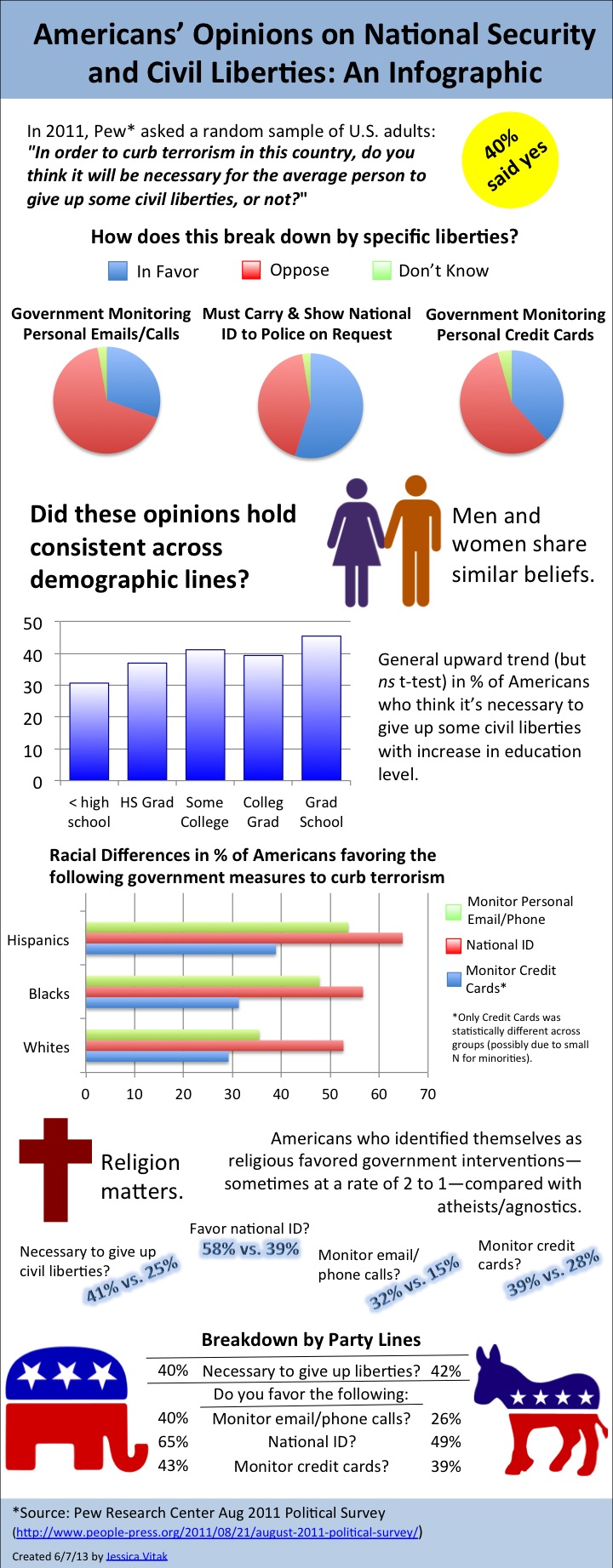
In light of the recent developments regarding NSA gathering data on Americans from various online and telecommunications sources, the Pew Research Center posted a blog highlighting some longitudinal data it has gathered since 9/11 on Americans’ attitudes toward relinquishing civil liberties. The post shows that over the last decade, fewer Americans believe that we need to relinquish our civil liberties “to curb terrorism.”

The blog post does not break down responses by any demographic factors, however, and after a tweet by danah boyd to Mary Madden at Pew Internet asking if there was going to be any further information about it, I, too, was curious. So I hopped into the SPSS file and did a few quick analyses. The result is my first-ever infographic, so please be gentle in your critiques of my artistry (I’m a researcher, not a graphic designer). You can also download a PDF of the infographic.

civil liberties infographic